Hong Kong's Prosperation and Bamin's Broad Melt into a New Picture-Fujian's Full Efforts to Promote the Deep Integration of Hong Kong's Production City and Shape New Advantages for Development
In 2025, the cargo throughput of coastal ports in Fujian reached 760 million tons, with the economic added value of coastal ports exceeding 795.5 billion yuan, accounting for 15.3% of the GDP of port cities. The economic added value of Fuzhou and Quanzhou ports both exceeded 200 billion yuan, placing them alongside Suzhou, Ningbo, Wuxi, and Tangshan in the top tier nationwide. The proportion of the economic added value of port cities in Fujian's coastal areas in the national total increased by 0.2 percentage points year-on-year, with the scale of port economic development continuing to grow, further highlighting its role in supporting regional economies. Xiamen Port's main ocean-going liner vessels consistently ranked among the top five globally in terms of average port and berth time, while Fuzhou Port's container operation performance ranked first in the world. From "channel construction" to "channel economy," from "transit economy" to "landed economy," and from "port-industry linkage" to "portside industrial belts," Fujian is not just presenting a report card but also chronicling the strides of its cities in leveraging the sea for strength.
Ports are not only gateways for external openness but also core engines driving regional economies and connecting inland hinterlands. In recent years, the Fujian Provincial Department of Transportation has aimed at building world-class ports, coordinating the deep integration of ports, industries, and cities, focusing on upgrading port infrastructure, expanding shipping networks, and constructing multimodal transport systems. By strengthening the "Silk Road Maritime" brand, Fujian has propelled its port and shipping industry from scale expansion to quality and efficiency improvement, charting a new course for high-quality development on the blue map.
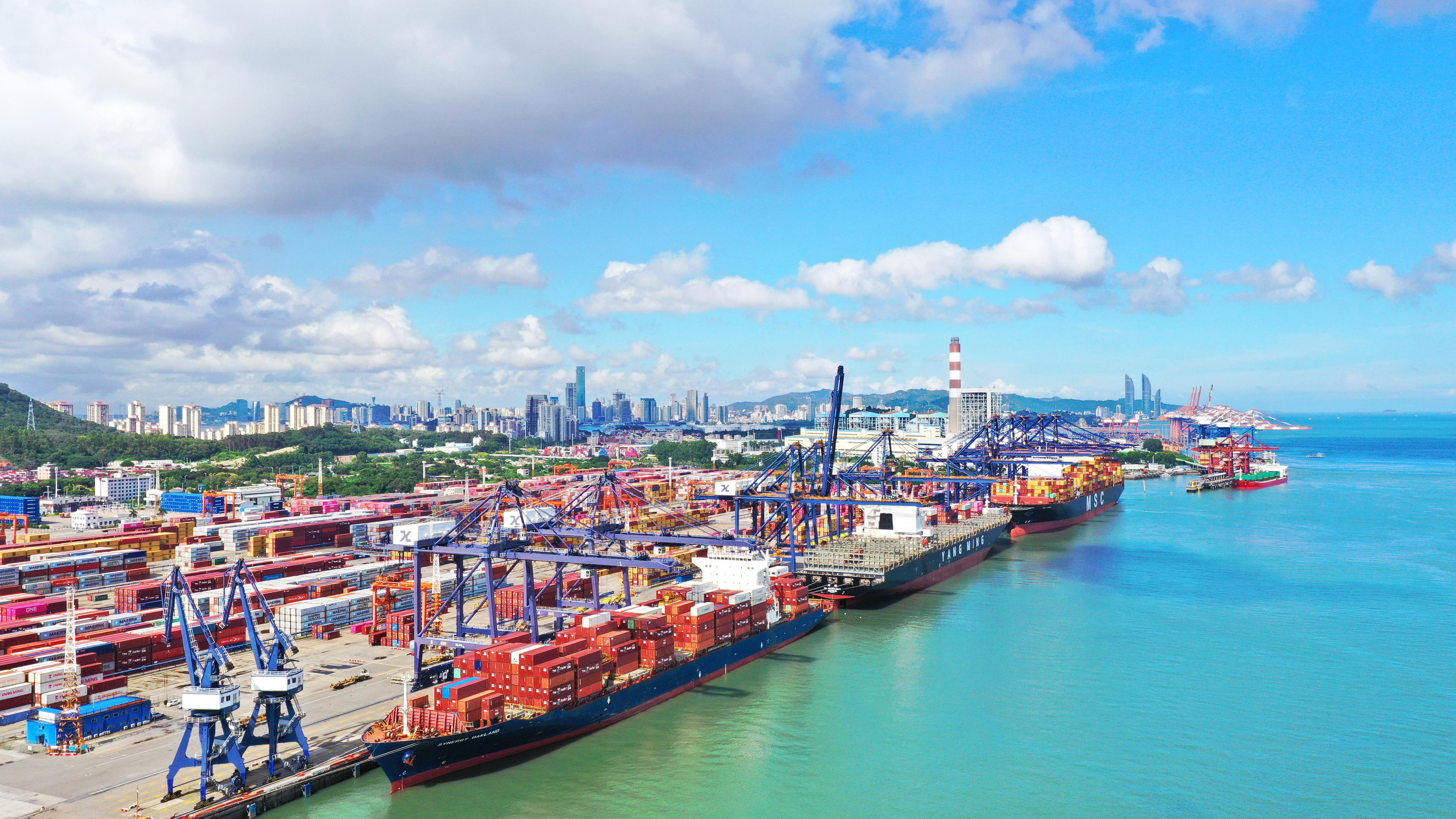
Deepwater Ports "Nurture" Trillion-Yuan Industries
Ports and cities must resonate in harmony and deeply integrate with industries to stand tall in the tide of openness. Ports serve cities, and cities thrive because of ports—this is a "two-way journey" between ports and cities. Fujian uses ports as leverage to drive the clustering of portside industries and elevate urban capabilities, carving out a unique development path of "gathering industries through ports, revitalizing cities through industries, and strengthening ports through cities."
In the Sansha Bay of Ningde City, Fujian, lies the renowned natural deepwater port—Sandu'ao Port Area. With its deep waters and wide harbor, it serves as the "gateway" and "throat" of the coastal region in eastern Fujian.
At the northern end of the natural deepwater port of Sandu'ao, the SAIC Group's Ningde production base, covering an area of about 2,100 acres, stands out prominently. Inside Asia's largest final assembly workshop for passenger cars at the Ningde base, robots and operators work in harmony, efficiently assembling vehicle components and main bodies. As the largest new energy vehicle export base in China, a complete vehicle rolls off the production line here every 53 seconds on average, with over 240,000 new cars shipped annually to destinations worldwide through its well-developed collection and distribution network.
The Zhangwan operation area, a key development zone of Sandu'ao, is a critical link in Ningde's three-dimensional transportation collection and distribution system, which connects the north to the south, the west to the east, and the rivers to the sea. It provides strong support for Ningde's efforts to build a trillion-yuan industrial cluster and an advanced manufacturing base along the southeast coast. Currently, the Zhangwan operation area has one 150,000-ton berth, five 50,000-ton berths, and one 30,000-ton berth. The leap in port capacity has directly translated into logistical support for Ningde's four leading industrial clusters: lithium battery new energy, new energy vehicles, stainless steel new materials, and copper materials, transforming this small city in eastern Fujian into the world's largest lithium battery industrial base.
Since the "14th Five-Year Plan," Fujian has continuously enhanced the capacity of its port infrastructure. The number of productive berths at coastal ports in the province increased from 420 to 479, berths of 10,000 tons or more rose from 184 to 221, and 10,000-ton-class channels extended to 325.7 kilometers, with an additional port cargo handling capacity of over 100 million tons. The actual throughput capacity of the province's ports reached 890 million tons, capable of accommodating the world's largest main ship types. Specialized terminal clusters for containers, bulk cargo, liquid chemicals, and other goods have begun to take shape. The natural advantages of deepwater ports are being transformed into strong momentum for industrial clustering.
At the Luoyu operation area of Putian's Dongwu Port Area, the 400,000-ton iron ore berth has achieved regular unloading operations, becoming the largest iron ore transshipment port for Taiwan on the mainland. Leveraging port advantages, the Shimen'ao operation area has established a "port + energy + storage + service" development model, serving projects such as the Fujian Yongrong Technology Caprolactam (CPL) project, the Shimen'ao production base of Three Trees, and the propane dehydrogenation to propylene industrial chain. This has accelerated the formation of a trillion-yuan national-level new functional materials industrial cluster in Putian.
In the Jiangyin Port City Economic Zone of Fuqing, manufacturers of wind turbine mainframes, generators, structural components, and blades have built factories near the port. The area boasts the world's most advanced MDI proprietary production line and the world's largest alkane integration production base. In 2025, the chemical industry output value of the park exceeded 100 billion yuan for the first time, earning it a spot on the "14th Five-Year Plan" list of the most competitive chemical parks. This "front port, rear factory" layout allows bulk raw materials to be delivered directly to workshops via dedicated terminals, and products to be shipped out immediately after production, significantly improving supply chain efficiency.
"Silk Road Maritime" Links Global Markets
Shipping routes are the "blood vessels" connecting ports to the world. Leveraging increasingly improved port facilities, Fujian has continuously optimized its shipping route network layout, building bridges for global trade.
Currently, Fujian's coastal ports operate 319 container liner routes, including 174 international routes, with approximately 2,100 sailings per month. These routes connect to over 60 countries and regions and reach more than 160 ports, supporting over 90% of the province's foreign trade imports and exports. Xiamen Port ranks 11th globally in connectivity.
At Xiamen Port's Haitian Terminal, rows of bridge cranes stand tall. A cargo ship loaded with over 6,000 items, including shoes, small appliances, and daily necessities for cross-border e-commerce, is about to depart. Two days later, this shipment will arrive at Manila Port in the Philippines.
This speed was unimaginable for Sun Kaiyang, General Manager of Xiamen Feixun Supply Chain Co., Ltd., in the past. "Previously, goods had to wait in a warehouse in Xiamen until a container was full, then be transported by truck to an out-of-town port two days before the ship's departure for loading and unloading, making it hard to ensure transportation efficiency. Now, goods are delivered, loaded, inspected, and set sail all on the same day, significantly shortening the logistics chain," Sun said. Xiamen has also innovatively introduced a multi-business consolidation model, allowing a single container to carry both e-commerce parcels and general trade goods, expanding the range of goods and offering more flexible customs clearance methods. "Overall, transportation time is reduced by two days, and shipping costs per container are reduced by 4,000 yuan, significantly enhancing market competitiveness."
This transformation is attributed to the launch of the "Silk Road Maritime" cross-border e-commerce express line. In June 2022, the first "Silk Road Maritime" e-commerce express line was launched. With the successive opening of e-commerce express lines, cross-border e-commerce goods now sail directly from Xiamen Port to major ports in Singapore, the Philippines, Malaysia, Vietnam, Thailand, and other countries.
The booming development of e-commerce express lines is a vivid reflection of the deepening and solidifying construction of the "Silk Road Maritime" brand. The "Silk Road Maritime" comprehensive shipping service brand, first proposed and implemented by Fujian, continues to release its brand's magnetic effect, becoming an important link connecting China and the world and bridging land and sea. Since its launch in 2018, the "Silk Road Maritime" alliance has grown to 375 members as of July 31 this year. The 148 "Silk Road Maritime" routes originating from over 10 ports across the country cover 150 ports in 48 countries and regions worldwide, establishing a major channel for integrated development of ports, shipping, and trade. "Silk Road Maritime" named container routes have operated 25,105 sailings, handling a container throughput of 29.4641 million TEUs.
Specialized routes such as e-commerce express lines, bulk cargo lines, and daily sea-rail intermodal services precisely match market demands, promoting closed-loop collaboration across the entire chain of ports, shipping, trade, and industries. This construction practice has been included in China's eight actions to support high-quality Belt and Road cooperation. Additionally, advancing the integrated development of "Silk Road Maritime" ports, shipping, and trade has been written into the national "15th Five-Year Plan" outline. From local exploration to national strategy, the international influence of Fujian's ports and shipping continues to rise.
Sea-Rail Intermodal Transport Opens Inland "Arteries"
The vitality of a port lies in its connectivity. Fujian has consistently expanded shipping routes outward and developed inland hinterlands inward, continuously deepening the construction of its sea-rail intermodal transport system. By breaking the barriers of mountains and seas, it has restructured the logistics landscape, extending the advantages of coastal ports to inland areas, opening up major arteries for foreign trade logistics, and making Fujian's seaports convenient gateways for inland provinces to access the sea.
The innovation of efficient intermodal transport models is the core secret to improving logistics quality and efficiency. Recently, the Ganzhou International Land Port to Xiamen Port sea-rail intermodal "single-ticket" export train was successfully launched, carrying furniture, bamboo products, and other inland specialties to Southeast Asia and Taiwan. With the new model of "one-time entrustment, one-ticket to the end, and one-time settlement," goods achieve "one container to the end, fully controllable throughout," significantly simplifying cumbersome operational processes, effectively reducing cargo damage risks, and making inland foreign trade transportation more efficient and stable, completely addressing the shortcomings of traditional segmented transportation with low efficiency and poor connectivity.
The innovative breakthrough in port-station dispatch mechanisms has laid a solid foundation for the development of sea-rail intermodal transport. In July 2025, Fujian's first sea-rail intermodal port-station joint dispatch center was established in the Jiangyin Port Area of Fuzhou Port. By restructuring traditional operational models and implementing an integrated mechanism of joint office and synchronized dispatch by multiple parties, it broke the segmented barriers of operations, achieving seamless coordination between railway unloading and port loading. Over the past year, the port area has directly unloaded and transported 20,933 TEUs, improving operational efficiency by 50%, reducing single-container transfer costs by 16.7%, and saving enterprises approximately 600,000 yuan in logistics costs.
To address the bottleneck in sea-rail intermodal transport for commercial vehicles, the Jiangyin Port Area pioneered the "arrival at station equals arrival at port" model, enabling vehicles arriving by rail to directly enter the port's rear yard for loading. This successfully shortened operational cycles and effectively avoided vehicle damage risks caused by multiple transfers. To date, the sea-rail intermodal transport channel for commercial vehicles has completed the roll-on/roll-off export of 3,120 vehicles, providing a more efficient logistics solution for the export of the automotive industry chain.
Relying on a mature intermodal transport system, Fujian's port hinterland continues to expand, and the intermodal network is becoming increasingly dense. Today, regular sea-rail intermodal trains operate between Bengbu, Anqing, Hefei East, and the Jiangyin Port Area of Fuzhou Port, forming a three-dimensional intermodal network covering 12 cities across Fujian, Jiangxi, and Anhui provinces. Goods from Hefei can reach Fuzhou Port within 24 hours. In the first half of this year, the container volume of this channel reached 4,166 TEUs.
The deep integration of "ports + railways" has enhanced Fujian's economic influence in central and western regions. The "Xinyu-Quanzhou" sea-rail intermodal transport channel at Meizhou Bay Port's Xiaocuo Port Area focuses on "sea-rail linkage, one container to the end, full connectivity, and high efficiency." By integrating railway, port, and maritime resources, it has eliminated logistical bottlenecks between ports and inland areas, achieving seamless connections for goods from inland to ports. Through optimizing operational processes, standardizing transportation, and strengthening information interconnectivity, it has reduced comprehensive logistics costs, providing terminal enterprises with more stable, efficient, and economical logistics solutions.
As a key link in weaving a dense network of intra-provincial port group interactions, the Xiuyu Port Area of Meizhou Bay Port has leveraged the existing "Putian-Xiamen" and "Putian-Jiangyin" internal feeder lines to create a new model for foreign trade logistics. Since April, the Putou operation area has implemented a "2+N" liner operation model, with two mainline sailings per week and flexible additional emergency sailings as needed. Coupled with high-quality empty container resources and efficient customs clearance services, this model addresses the pain points of foreign trade enterprises, such as difficulties in obtaining containers, complex processes, and high costs, opening a convenient "doorstep to the sea" channel for Fujian goods.
A series of innovative measures have yielded remarkable results in promoting land-sea linkage construction. Data shows that in 2025, the volume of sea-rail intermodal containers transported through Fujian ports from outside the province reached 188,000 TEUs, a year-on-year increase of 33.5%. In the first half of this year, the volume exceeded 122,000 TEUs, a year-on-year increase of 44.2%.
Mountains embrace the sea, and connections extend far. The roaring China-Europe freight trains and sea-rail intermodal trains have broken the geographical constraints of inland provinces without access to the sea, enabling Jiangxi's minerals, Sichuan's light industry, and Hubei's equipment to set sail from Fujian's seaports. Fujian uses sea-rail intermodal transport as a link to connect inland hinterlands with international markets, continuously invigorating economic vitality.
"Fujian's ports have become a 'pillar' of economic development, not only shouldering economic responsibilities but also serving as crucial support for connecting inland regions to global markets," said Lei Wenzhong, a member of the Party Leadership Group and Deputy Director of the Fujian Provincial Department of Transportation. To further enhance the capacity of port hubs and strengthen Fujian's marine economy, the provincial government recently approved and jointly issued the "Measures to Accelerate the Construction of World-Class Ports and Promote the Integrated Development of Ports, Shipping, and Trade" in collaboration with three departments. The measures outline 17 tasks across five areas, including infrastructure, resource integration, multimodal transport, portside industries, and business environment, forming a "combination punch" to transition ports from "individual battles" to "united fists." The goal is to build a modernized southeast coastal port cluster with comparative advantages, connecting both sides of the Taiwan Strait, linking the Yangtze River Delta and the Guangdong-Hong Kong-Macao Greater Bay Area, and radiating to central and western regions.
The tide rises in the southeast, striving for maritime strength. As the "15th Five-Year Plan" begins, Fujian will aim to build world-class ports, deepen the integrated development of ports, shipping, and trade, continuously strengthen infrastructure, optimize shipping services, expand inland hinterlands, and deepen the integration of ports, industries, and cities. In serving the construction of a new development pattern, Fujian will act as a "maritime pioneer," striving to write a blue chapter of Chinese-style modernization in the era of land-sea linkage and cross-strait integration!
□Commentary
Moving Beyond "Throughput Thinking": Maritime Development Goes Beyond Ports
Thriving by the sea goes beyond ports. Fujian's vivid practice of integrating ports, industries, and cities breaks away from the traditional single data-driven mindset, redefining the core logic of port development, industrial clustering, and urban enhancement in the new era, providing a new paradigm for high-quality development in coastal regions.
The core competitiveness of ports lies in their dual connectivity as hubs. Fujian has abandoned the traditional perception of "focusing on loading and unloading while neglecting empowerment," no longer limiting ports to physical nodes for cargo transshipment but transforming them into strategic hubs linking domestic and international dual circulation. Leveraging the "Silk Road Maritime" brand, Fujian has innovatively launched cross-border e-commerce express lines and specialized bulk cargo routes and implemented precise services like the sea-rail intermodal "single-ticket system," directly addressing global supply chain efficiency bottlenecks. This has driven ports to transition from passively handling cargo to actively integrating logistics, trade, and industrial resources. Meanwhile, the increasingly dense land-sea intermodal network has broken geographical barriers, extending port hinterlands from coastal areas to Jiangxi, Anhui, and central and western inland regions, making Fujian's seaports convenient gateways for inland provinces to access the sea. This fully demonstrates that the value of modern ports lies not in mere throughput tonnage but in their ability to deeply embed into regional industrial, supply, and value chains with low costs, high efficiency, and excellent services.
The core advantage of industrial clustering has never been about proximity to ports but about deeply embedded symbiotic capabilities. True port-industry integration is not merely about businesses being located near water but about the deep coupling of ports and industries, where they thrive together. Fujian's breakthrough lies in spatial restructuring through the "front port, rear factory" model, achieving iterative upgrades in portside industrial development and transforming industries from "proximity to ports" to "relying on and empowering ports." Key port areas like Ningde's Sandu'ao, Fuzhou's Jiangyin, and Putian's Meizhou Bay have leveraged the natural advantages of deepwater ports and dedicated terminal facilities to establish closed-loop chains where raw materials are delivered directly to workshops and finished products are shipped out immediately. This has transformed port logistics advantages directly into industrial competitiveness. Ports are no longer standalone facilities but extensions of industrial chains and core supports for industrial clusters, breaking down the barriers of port-industry separation and independent operations.
Cities thrive because of ports, industries thrive because of ports, and ports are strengthened by cities. Fujian's practice demonstrates that the integration of ports, industries, and cities is not a simple addition or mechanical combination of the three but a systemic transformation driven by ports as core leverage points, reshaping spatial patterns, reconstructing industrial systems, and reorganizing regional collaboration. From pursuing port scale expansion to focusing on comprehensive capacity upgrades, Fujian has achieved a profound leap from "building ports" to "revitalizing industries, prospering cities, and energizing regions," providing a highly instructive practical model for coastal provinces in the new era to manage marine resources, integrate land and sea, and promote high-quality integrated development of ports, industries, and cities.
-
The embankment grows fresh greenery, egrets accompany the boat's journey — embarking on a boat to explore the "beautiful waterway" of the Li River.4764
-
The first zero-carbon container shipping route in the Guangdong-Hong Kong-Macao Greater Bay Area has officially been launched.3824
-
The Seminar on Empowering New Productive Forces in Marine Oil and Gas Engineering Equipment Was Held in Fuzhou.3191
-
Fighting "foreign lawsuits" well is the essential skill for Chinese companies going global.4461
-
The International Training Program on Green and Low-Carbon Shipping Technologies for the Belt and Road Initiative Kicks Off3621