Extend eastward to open up new domains! Completion of Bid B of Xiaoyangshan North Wharf
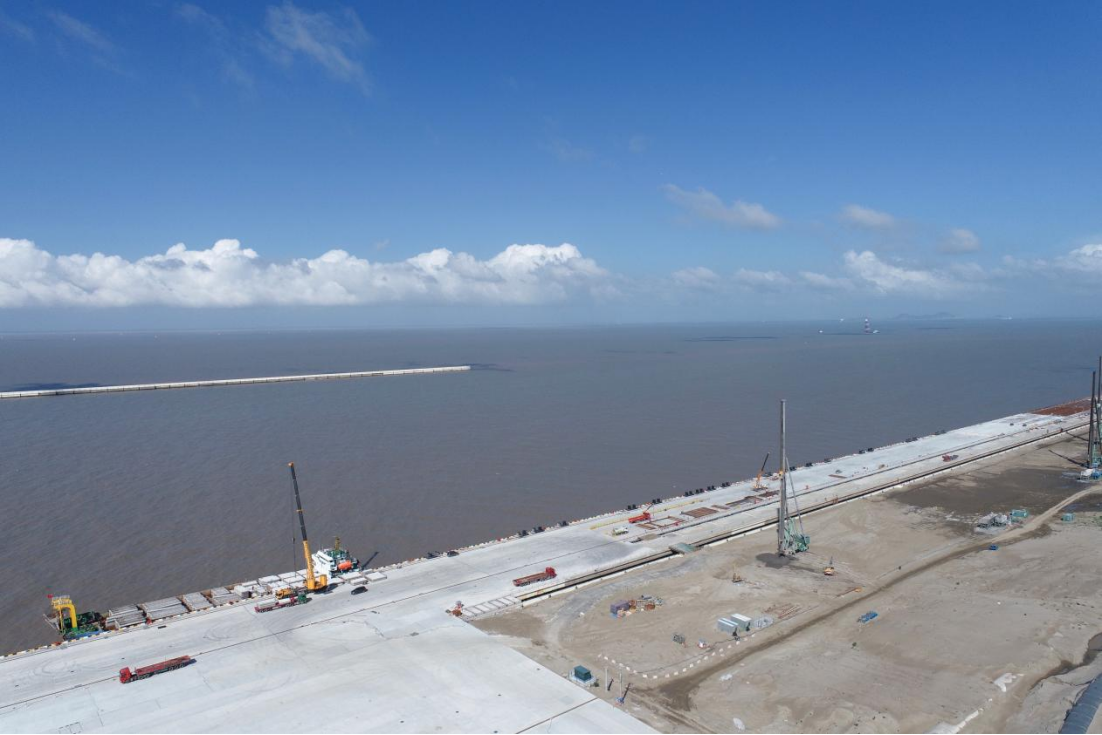
On August 28, the main structure of the Wharf Project Section B of the Container Terminal and Supporting Project at the Xiaoyangshan North Operation Area of the Yangshan Deepwater Port, part of the Shanghai International Shipping Center, constructed by China State Construction Port and Shipping Bureau, was completed.
The construction content of the Wharf Project Section B of the Container Terminal and Supporting Project at the Xiaoyangshan North Operation Area includes a 612-meter high-pile beam-slab wharf with a front water depth of -11.8 meters. It also has wave and surge protection functions and serves as the core operational area for future large vessels to dock and load/unload.
Turning the Disadvantage of Tides into an Advantage
The Xiaoyangshan North Operation Area is adjacent to the open sea without natural barriers, making it susceptible to frequent surges and variable water currents due to monsoons and terrain. Conventional tide-dependent construction often has to "make way" for the tides, significantly reducing effective working hours and posing considerable challenges to the project.
To address this issue, the project team tailored the construction plan to local conditions, optimizing it based on tidal patterns. They developed a dual-layer construction model of "upper and lower layered operations, land-sea coordinated parallel work," aligning with the rise and fall of the tides. When the tide rises and the sea level elevates, they focus on surface rebar binding, formwork installation, and concrete pouring. When the tide recedes and the work surface is exposed, they immediately proceed with installing pile caps, transitioning support systems, and advancing lower-level operations. Each step forward is a race against weather and sea currents.
Additionally, the project adopted a "prefabrication-cast-in-place separation" method, breaking down the wharf construction into modular operations. Large and heavy beam-slab components were prefabricated in a land-based factory and then transported by sea to the construction site for installation. Only high-precision and complex processes, such as node connections and structural adaptations, were retained for on-site casting at sea.
This construction model completely transformed the traditional passive state of "work stops when the tide stops," achieving an all-weather construction mode of "work moves with the tide, workers follow the tide." It turned the "stringent restrictions" of ocean tides into a "hidden engine" driving the project timeline.
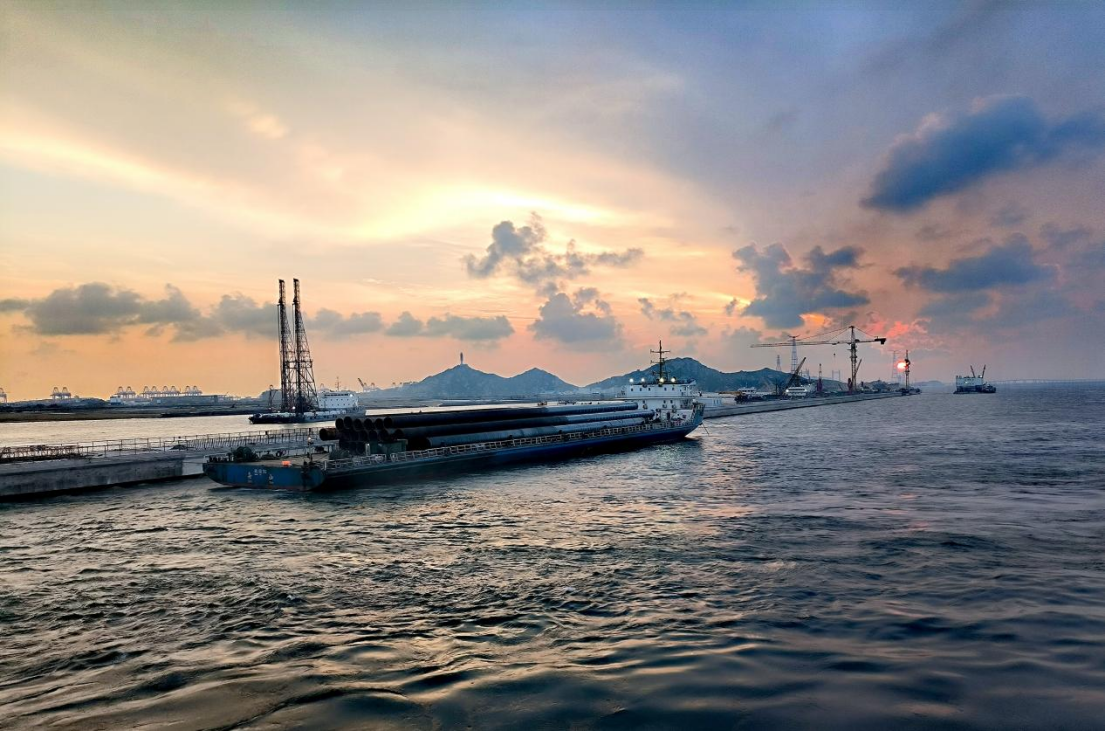
Adding Long-Lasting Close Protection to the Wharf
The open sea area is a "natural corrosion testing ground" for port engineering. High salt spray, constant tidal erosion, and the penetration of chloride ions in seawater impose far more stringent durability requirements on the concrete and steel structures of the wharf than on ordinary land-based projects.
The project team established a full-chain durability assurance system of "material optimization—structural reinforcement—process precision control—long-term protection." For concrete protection, they selected high-durability specialized concrete suitable for deep-sea environments, scientifically adding anti-corrosion modified admixtures to create a dense and flexible invisible protective net within the concrete.
For steel pipe pile protection, the project developed a multi-layered, complementary anti-corrosion solution. The surface of steel pipe piles exposed to wave impact and water level changes was coated with high-strength composite anti-corrosion coatings. For the sections of piles deeply embedded underwater, special anode blocks were installed to provide continuous protective effects around the clock.
To address the challenges of deep-sea welding points being hidden, difficult to observe with the naked eye, and hard to inspect for potential issues, the project used specialized welding rods suitable for deep-sea environments, combined with self-developed imaging detection technology. This enabled high-definition imaging, full-process recording, and traceable inspection of every underwater weld.
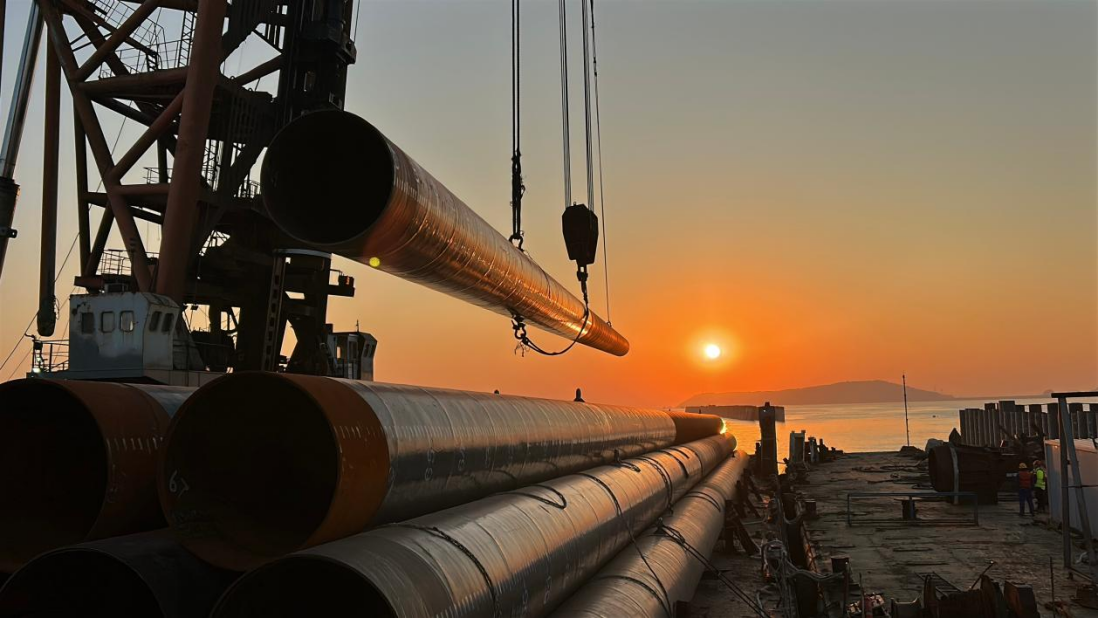
The Power of Digital Intelligence Makes Offshore Construction Scientific and Secure
Offshore wharf construction requires precise organization and seamless coordination. Traditional experience-based construction often leads to issues such as equipment conflicts, material pile-ups, process interruptions, and resource idling. To address this, the project fully implemented a digital intelligent construction system, shifting offshore construction from "relying on experience" to "relying on data."
The construction site was equipped with 27 sets of pile cap support systems and 9 sets of customized integrated steel templates, employing dual-line parallel construction. Using BIM technology, the team completed full-process construction simulations in advance, scientifically divided independent work areas, and precisely allocated manpower, equipment, and other resources.
For vessel and machinery scheduling, the project utilized a vessel and machinery scheduling management platform, integrating AIS ship identification, Beidou positioning, and video monitoring. This provided real-time visibility into vessel navigation trajectories and on-site operational status. By combining tidal windows, construction priorities, and equipment status, the system automatically generated optimal vessel dispatch plans, breaking the inefficiency of "people waiting for ships, ships waiting for people" and achieving efficient circulation and precise deployment of vessel and machinery resources. Electronic fences and collision warnings were also set up to establish an all-weather, multi-dimensional safety barrier for navigation in the construction waters.
It is understood that the Xiaoyangshan North Operation Area is an important part of the Yangshan International Container Hub Port Area of the Shanghai International Shipping Center. It will become the largest single automated terminal at the Port of Shanghai. Since 2022, China State Construction Port and Shipping Bureau has successively undertaken multiple projects in the Xiaoyangshan North Operation Area, effectively promoting regional cooperation and comprehensive development in Xiaoyangshan. This will further enhance the overall advantage of the Yangtze River Delta's world-class port cluster in river-sea intermodal transport, play a leading role in strengthening the functional position of the Shanghai International Shipping Center, and improve China's international shipping competitiveness while expanding higher-level openness to the world.
-
The embankment grows fresh greenery, egrets accompany the boat's journey — embarking on a boat to explore the "beautiful waterway" of the Li River.4764
-
The first zero-carbon container shipping route in the Guangdong-Hong Kong-Macao Greater Bay Area has officially been launched.3824
-
The Seminar on Empowering New Productive Forces in Marine Oil and Gas Engineering Equipment Was Held in Fuzhou.3191
-
Fighting "foreign lawsuits" well is the essential skill for Chinese companies going global.4461
-
The International Training Program on Green and Low-Carbon Shipping Technologies for the Belt and Road Initiative Kicks Off3621